Image From: Traklife Network
7 minute read
July 14, 2025
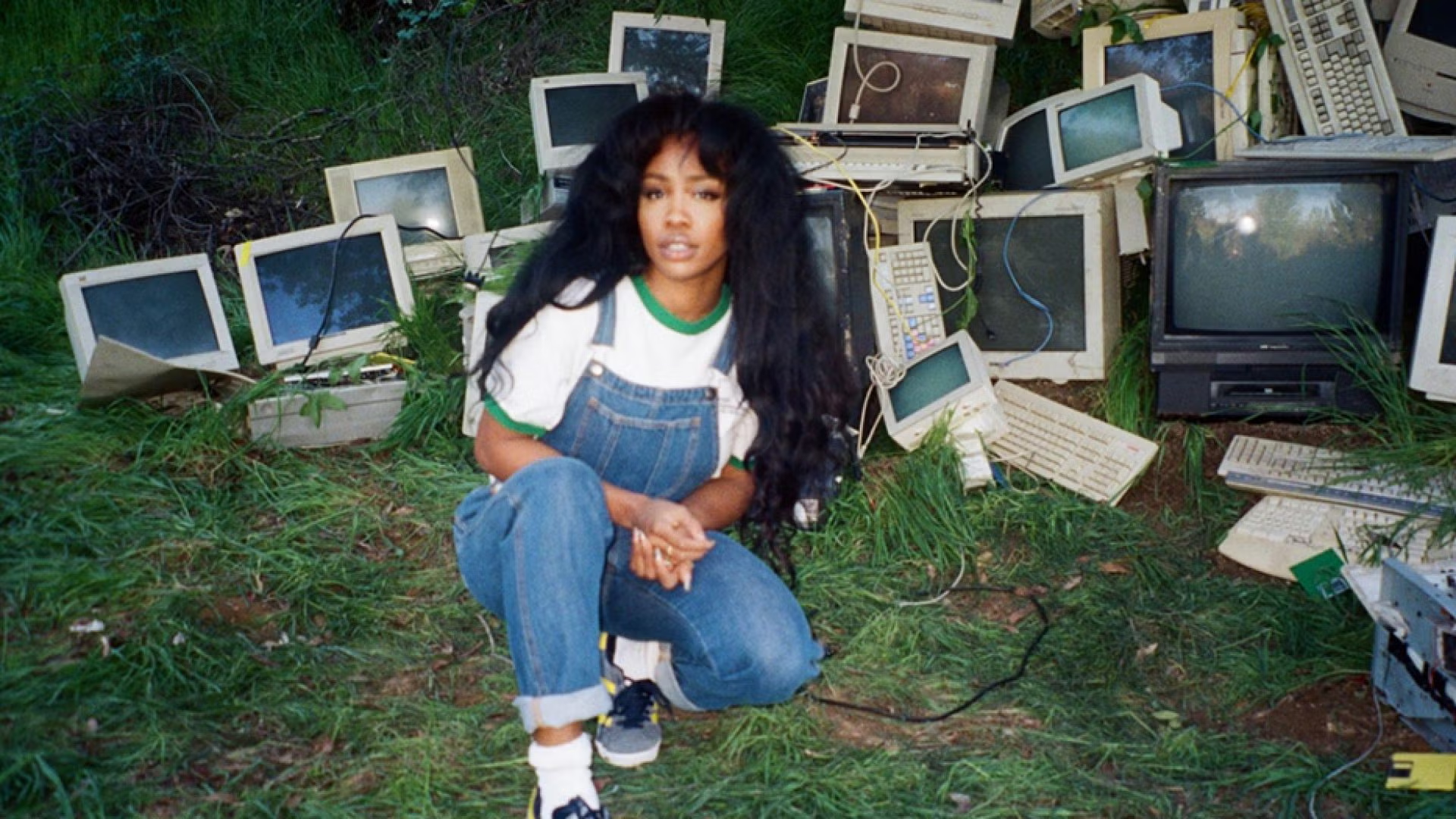
If you have been scrolling through TikTok, you may have heard a portion of SZA’s Demo of “Wavy Interlude.” The lyrics “Me and Ashley” are a known phrase of this song, highlighting the relationship between two Black girls who have faced hardships living in Suburbia. My focus, however, is on the lyrics,
The price of being black in Suburbia
Daddy ain’t workin’ and you just
Tryna’ measure up to the rich kids
With they Jansport Backpacks
With they name on it
I wanted to begin my journey on this blog by introducing one of my most prominent struggle as a Black girl, one that I know many others can relate to, especially growing up living in the Bay Area where competition is cutthroat and we have to work hard, if not harder, to fit into communities where we may not feel as supported; being referred to as Whitewashed.
The Breakdown of SZA’s Lyrics
To provide better context for my story, I will break down this excerpt line by line.
“The price of being black in Suburbia” sets the theme for the rest of the demo. It mentions the cost (emotional, social, cultural, or financial) of being a Black person in a predominantly white, middle-class, or upper-class suburban area. The word “Price” signifies that there is a toll to be paid, possibly in identity, dignity, or opportunity.
“Tryna’ measure up to the rich kids” describes a sense of inadequacy or a desire to fit in with your peers. The phrase “measure up” suggests that there is a standard that the speaker feels they fall short of. There is an internal battle between self-worth and social comparison.
“With they Jansport backpacks” enhances a seemingly small but symbolic status marker associated with standard and mainstream American school culture. It becomes a representation of privilege and inclusion.
Lastly, “With they name on it” is a detail that connected personalization and identity into one. On a surface level, it contrasts the speaker’s lack of privilege and resources, but it also implies how wealthier kids don’t just have money, but also a stable identity and sense of belonging that the speaker craves.
The TikTok Trend
As mentioned previously, the popularity of this demo by SZA has grown drastically over the last few weeks, with many, specifically Black girls in predominantly white spaces, posting their connection to the lyrics. One TikTok in particular stood out to me the most. A video made by a user named its.nashh, showcases how, throughout her childhood, she continues to be referred to as “whitewashed”, signifying how that is her “price” of being Black in Suburbia. While one In her comment section, viewers are proving her point as some replied that “The leg pose said it all”, indicating how the pose she makes in the video is one that the commenter believes mainly White girls do. Another comment states how they are “Glad that you’re [she] is self-aware”, because of how its.nashh presents herself online. Factors, such as how a Black person speaks, dresses, what they’re interested in, their personality, and who they surround themselves with, all play into whether or not they are considered “whitewashed” by others.
A Dive into My Experience Being Called “Whitewashed”
Opening up about my experience: My childhood struggle between finding balance in being unapologetically myself and meeting the expectations of others.
Growing up, I was enrolled in a predominantly white kindergarten class, a semi-diverse elementary school, and a predominantly white middle school. In kindergarten, I attended a predominantly white school in Los Altos where I was forced to wear plaid skirts and dresses that covered my knees. Then, in elementary school, my hair was constantly relaxed to make it easier to manage and maintain, and, by middle school, I was met with the struggle of separating who I wanted to be from what others wanted from me. I became a product of my environment.
I attended a prestigious middle school because my parents and I wanted me to receive a high level of education before high school. This school was known for teaching a grade or two grades ahead, and I pursued that because I wanted it for myself. There, I was one of the three Black girls in my grade, and it stayed that way up until seventh grade, when two other Black girls transferred to my school. We found likeness in each other, not simply because we were the only Black girls in our grade, but because we experienced this impact together.
I was seen as the “nice girl” who didn’t step on anyone’s toes, and to be honest, I enjoyed being portrayed in that light because I was just being myself. On occasion, I wondered if I was deemed the “nice girl” because of who I was as a person, or if I was just “nice” for a Black girl. I straightened my hair, not because I knew that my peers liked the way it looked on me, but because I believed it looked nice. Like many, I kept up with the trends on TikTok and grew a specific style, but not because I knew it was popular amongst the White community, but because I thought it was cool and cute. I’ve always talked in a “proper nature” and used “big words”, which, before then, I did not realize was not stereotypical for a Black girl. I did this, not because I was trying to be perceived more positively by my peers, but because that is how I was raised. Still, is that an excuse to call me whitewashed?
However, the more I became aware of how I was perceived by my peers, the more I conformed to fit into what was deemed “acceptable” in my environment. Still, it is unfair to call Black girls whitewashed when in those same settings, they are often made to feel inferior for embracing expressions of Black identity that fall outside of what’s considered “appropriate” or “beautiful” in predominantly Western society.
The Truth of the Trend
Do not get me wrong—I enjoy watching the countless versions of the “Me and Ashley” trend while scrolling aimlessly through my TikTok “For You” page; however, this seemingly lighthearted trend also opens the door to a deeper conversation worth exploring.
This trend’s relevance makes it clear that this circumstance extends beyond my experience—it reflects a broader narrative shared by thousands of other girls who look like me. It has begun to spark the necessary conversation about the complexities of growing up Black in spaces where this attribute isn’t always embraced. While it won’t resolve the deeper, systemic issues at play, it serves as a catalyst for fostering greater understanding and empathy toward the forgotten and overlooked experiences of Black youth in these environments.
Being labeled as “whitewashed” is inherently racist. It is a blanket term that fails to conceal the ever-harmful notion that there is a singular, prescribed way that Black individuals exist, behave, speak, and present themselves.
The Importance of Understanding this Experience
I wrote this piece to raise awareness about an issue that many Black people, like myself, have gone through. I am not writing this to cause further dispute or problems, but rather to showcase my experiences and to hopefully provide a sense of comfort and familiarity for other Black girls. I want Black youth who have gone through a similar experience to realize that they are not alone, and that there are people who are willing to support them and listen to what they have endured, despite how “crazy” or “complicated” it may sound.
Currently, I am not yet in a place where I feel fully confident or content with who I am, but I am actively building a stronger sense of identity and self-worth. I am proud of the steps I have taken to get to this point in my life, and I recognize there is still much growth ahead. I am learning to navigate the space between who I truly am—Amaya DeFlorimonte—and what society deems acceptable for a Black girl.
The “price” of being Black in suburbia, for me, has been being labeled as whitewashed; however, that label does not define me, and I refuse to let it.

Leave a Reply