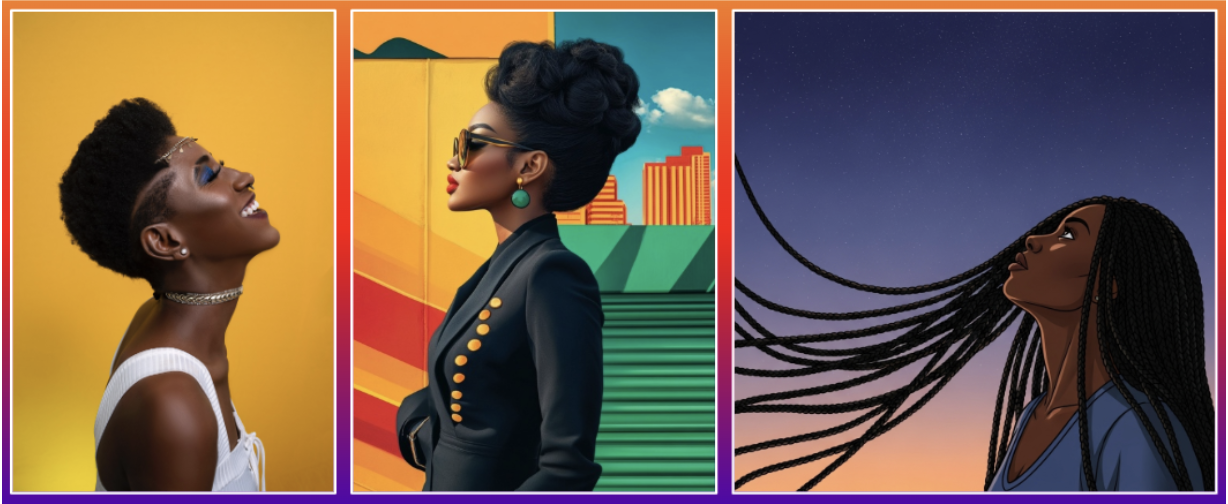
Left: pxhere.com, Middle: publicdomainpictures.net, Right: easy-peasy.ai
10 minute read

Oct. 24, 2025
As a Black community, we are known for so many things. From our unapologetic sparkle and unmatched style, to our fierce resilience against adversity –and of course, the crown jewel: Our hair. But heavy is the head that wears the crown, and the roots of these beautifully intricate styles stem from a long, complex, and often forgotten history.
Being a Nigerian girl with sisterlocks in the United States, I’ve witnessed the recent reclamation of our hair and pride in natural styles. To further appreciate this embrace of Black culture and shift away from Western beauty standards, I think it’s essential that we remember the difficult journey our hair has undergone and understand the evolution of Afro hair throughout the United States. As I trace the history of Black hairstyles from thousand-year-old ancient African traditions, to slavery and colonial erasure, and ultimately, exclusive present-day interviews from Black voices at my own high school, Bishop O’Dowd, I hope you gain a greater understanding of the resilience of our sparkling crown jewel.
Cultures Around the World
The history of hair braiding can be found in numerous cultures across the world, each with its own unique style and technique. For instance, Native Americans have many spiritual hair braiding practices, such as the Indigenous women in the Plateau region of Idaho who are known for wearing their hair in a slick middle part separated into two long braids. Furthermore, the famous Caryatid sculptures placed on the Erechtheion roughly between 421 and 406 BCE reveal the intricate fishtail braiding skills of the Ancient Greeks. Additionally, several other European countries have also had a variety of braiding styles during the Middle Ages, as often shown in Viking depictions.
However, as a Black girl living in the US, the form of braiding that I’m most familiar with is traditional West African hair braiding. Some of my earliest memories of hairstyling, before embarking on my sisterlock journey, occurred at a local African hair braiding salon near my house. I remember always complaining about the tight pull of the cornrows during the process, but also being completely amazed by the intricate end result. These hairstyles aren’t just stunning (and yes, admittedly, too tight for those of us who are more tender-headed!)- but also the oldest known origin of braiding worldwide, with the earliest archeological evidence of hair braiding stemming from the Himba people of Namibia as early as 3500 BCE in Southern Africa. They are believed by archeologists to be the first people to practice the art of hair braiding, making it a long-lasting and integral part of Black culture today.
The Transatlantic Slave Trade
Braiding is a deep symbol of empowerment and a fundamental representation of our ancestral roots in the Black community. It has stood the test of time and blossomed throughout the African diaspora, despite many attempts at westernization and appropriation that deprive our community of its rich culture and legacy.
Throughout history, many people have tried to use our hair as a way to subjugate us and make us feel that we weren’t enough. During the transatlantic slavetrade, European slave traders would shave the heads of enslaved West Africans as a form of punishment and dehumanization, due to our hair being a powerful source of pride, culture, and joy. This forced removal of Black culture was their way of sending a message about how the previous identities of the enslaved were being stripped away and now controlled by their colonial masters.
Slavery in the Americas
Once slave traders brought West Africans to North, South America, and the Caribbean, they sold them into slavery, where they continued to face oppression and abuse. However, despite these injustices, Black Americans developed ways to express the beauty of our culture through hair: For instance, cornrows, which, according to Byrdie magazine, date back to around 3000 B.C in the Horn and West coast of Africa. In the Caribbean, they were referred to as “canerows”, due to the sugar cane fields where enslaved people were forced to work endlessly in the heat. According to folklore, these intricate cornrows included hidden messages that depicted escape routes and guided many people towards the path to freedom away from plantations.

Traditional West African Cornrows, Source: pxhere.com
This grim past serves as a reminder of the significance of cornrows within the Black community and is, always, a surprise to many. For instance, this week, my older brother, Olani, is planning on getting his starter locs styled back into barrel twists, which look quite similar to cornrows. Earlier today, I described to him the complex history of Black hairstyles to see how our conversation could help deepen his connection with his hair. After learning about the rich history of cornrows, he expressed,
“It’s interesting to know that’s part of my culture- That makes me feel a sense of pride about my hair and its origins, and I feel I’ll wear styles with more confidence after knowing that.”-Olani, O’Dowd Class of 2026
It’s vital that people from other cultures seek to understand the history of West African braiding, as opposed to engaging with it solely as a fashion trend to appropriate, as this often overshadows its painful origins and the prominent legacy of our ancestors.
Cultural Appropriation of Black Hairstyles
Let’s jump forward in time. Lately, a hot topic online has been the frequent exploitation of Black culture amongst white celebrities, as seen especially in the Kardashians’ history of cultural appropriation. The term “cultural appropriation” is often stigmatized due to frequent overuse and misunderstandings in the media. Rather than being understood as the way in which dominant Eurocentric cultures unethically borrow customs from marginalized groups, the phrase tends to be misused and confused with natural forms of cross-cultural exchange. A true example of cultural appropriation at its core that demonstrates its severe harm is the theft of unique hairstyles, languages, and fashion from people of the African diaspora. These styles are oversimplified by being called “trendy” and ultimately face exploitation when worn by people outside of the Black community who don’t fully understand our lived experiences or the weight of these styles, many of which have faced historical demonization.
Western Beauty Standards
For example, the CROWN Research Study discovered that Black women’s hair is two-and-a-half times more likely to be seen as unprofessional than other races. Additionally, offices send home 20% of Black women between the ages of 25 and 34 because of their hair. In fact, as a Black community, we face so much prejudice about our hair at work that, as of recently, 27 states have passed their own variation of the CROWN Act, a law prohibiting work-based discrimination on race-associated hairstyles. Unfortunately, this form of discrimination is not outlawed nationwide, arguably reflecting the ongoing racism in America today. These forms of prejudice have led to a historical trend of Black women straightening their hair, often due to the desire for acceptance within a society dominated by Eurocentric beauty standards.
As a “4c-girlie” myself, I understand the internal conflict that stems from only seeing straight hair and looser curl patterns represented as the main beauty standard on TV, social media, and even at school. To make matters worse, a lot of hair care products aren’t aimed towards helping us manage our 4c hair: popular leave-in conditioners create residue and buildup, gels are a recipe for disaster with constant flaking that dries out our tighter curls, and I’m still looking for an edge control that will actually lay kinkier coils. All of this has even led to prejudices within the Black community, with loose, wavy curl patterns being seen as “prettier” and “superior” to kinkier hair textures. These Western ideals can be extremely damaging, not only physically–due to the consequences of straightening our natural hair–but also mentally, due to the internal turmoil and self-hate they can escalate into.
Celebrating Cultural Hairstyles
Today, Black hairstyles continue to thrive throughout the community and have evolved into a multitude of unique styles. Locs such as my own have been found in Africa for thousands of years. Egypt in particular has a very longstanding history of dreadlocks, and it has helped pave the way for the numerous types of locs found in the African diaspora today: From dreadlocks, to sisterlocs, bellalocs, microlocs, and traditional locs, to methods such as crocheting, palm rolling, and interlocking- the list goes on and on!

Photo of Loc Icons Halle and Chloe Bailey, Source: commons.wikimedia.org
Being the only girl with locs in my grade has really helped me understand how staying true to your natural hair can feel both liberating and isolating. Many times, people have asked me genuine questions that are, in fact, quite bizarre and insensitive, like,
“Wow, does your hair just naturally sprout out into locs?” and “Why are your dreadlocks so thin?”
These days, locs are often associated with a more “masculine” image in the media, so female loc icons like the Bailey sisters are seen as unique outliers. Regardless, I chose to wear my locs not only as an act of resilience but as a form of self-love and connection to my African roots.
At Bishop O’Dowd, there are other students and faculty who celebrate having locs. When asked about what inspired them to begin their loc journey, they shared:
“I’ve had my locs for four years! My mom had locs, and I always loved the look of them: I thought it was so feminine and so beautiful! I love my hair, because it really flourishes in this, and I never plan to cut them off!”
– Marlo, O’Dowd, Class of 2027
“Some of my cousins had locs, and that became an inspiration for me to get them. My locs have truly become a symbol for my identity, because as you grow, your hair grows with you.”
– Mr. Tesfaye
Despite attempts at Westernization and the formation of a more homogenous society that erases Black history and culture, our community continues to embrace having Afro hair and staying true to this deeply inspirational aspect of our identity. Currently, there are so many styles that honor the uniqueness of Afro hair textures and the longstanding history of braiding. With goddess braids, twists, natural ‘fros, bantu knots, and laid edges, we continue to keep our hair slaying and on point despite society’s judgment. It is so incredible to see this shift towards celebrating Black hair and uplifting our culture after the painful history we’ve faced to get here. Our hair has traveled through a powerful timeline of ups and downs, but even today, we’re still evolving and learning to redefine beauty standards through the peaceful resistance of our hair.
I’m so grateful to be living in a society where we can appreciate the uniqueness of kinky hair textures and embrace the beauty of our hair!
It’s a heavy crown, but I wouldn’t trade it for anything.

Leave a Reply