10 minute read
July 25, 2025
Fashion is political –and not because of you and your bestie’s yearly dilemma of arguing over which celebrities’ Met Gala look was the best. Rather, fashion is political because it is constantly reacting to the ever-changing political landscape of the country. This political landscape influences how we view each other, the distinct choices we make between wearing baggy wide-leg jeans or skinny jeans, and even the media’s preference for embracing the body positivity movement or riding the wave of an ever-growing diet culture.
To be as simple as possible: the impact of politics on fashion affects how we as women live, eat, and breathe in our bodies.
Fashion and Politics’ Seemingly Symbiotic Relationship
It is undoubtedly evident that over the past six months, there has been a significant shift in the country’s ordinary, day-to-day operations. Whether you align yourself with a more liberal or conservative ideology, or even if you choose to take no part in politics at all, a new US presidency has and always will impact the way we live our lives.
Similarly, even if you believe yourself not to be heavily immersed within the world of fashion, the numerous trends, customs, and practices that emerge from it each year will typically always find their way into your closet one way or another.
But why am I even talking about fashion and politics in the same article? Why am I, Zenze Taylor, bringing these two categorically separate and seemingly disconnected facets of society together as if they are one? Well, from my 17-year-old perspective, each year of which I’ve lived is characterized by a distinct period of prominent political beliefs, injustices, and social movements –along with the numerous fashion trends that accompanied them.
For instance, 2016 was the year of multicolored bomber jackets, the last few months of President Obama’s administrative term, the popularization of the curvy body type, athleisure, and the rise of female gym culture –much of which was driven by women’s efforts to achieve the then ‘slim waist-wide hip’ ideal body type. It was the United States’ signing off on the Paris Climate Agreement, people sporting chunky Filas Disruptors, white Adidas Superstars, and dark denim jackets. It encompassed the determined efforts of climate change activists raising awareness about the ever-growing threat of global warming, the year of edgy leather choker necklaces, racial justice initiatives driven by the Black Lives Matter Movement, the “Hypebeast Style”, and Retro Air Jordan 6s.
But how do these distinct fashion-related choices and political actions intersect? What is their relationship, and how do they interact?
Conservatism is In, and Progressivism is Out —At Least for Now
To answer your hypothetical burning question regarding this topic, I’ll briefly summarize the newfound socio-political norms of today:
Donald Trump is a 79-year-old white Republican, media personality, billionaire, adjudicated convicted felon, and the 47th president of the United States. So far, the second term of his presidency has set forth an influx of conservative American values and practices throughout the country.
Values encompassing the practice of traditional gender norms that reinforce the modern patriarchal system, support for a more theocratically influenced nation, heteronormativity, and an embrace of religiously-fueled pronatalist policies –all of which have influenced recently passed restrictions to reproductive healthcare and specifically, the criminalization of abortion access across 12 states.
Additionally, the administration’s current governmental practices have reflected an emphasis on wealth-driven leadership in government, along with a significant increase in pro-American and anti-immigrant sentiment regarding the economy, public safety, and population growth.
From the Ethnically Ambiguous “Insta-Baddie” to the Vintage, “Quiet Luxury” Minimalist
If you’re into fashion like I am, or simply just a teenage girl with an active TikTok ‘For You Page’, you’ve likely kept up with the constant shift in what “the cool girls seem to be wearing” each season online.
I’ve had TikTok for around five years now, and let me tell you: from the oversized graphic tees and Air Jordan 1s of 2019 to the vintage low-rise jeans, Miu Miu ballet flats, and ‘cottagecore’ milkmaid sundresses of today, I’ve sure seen fashion trends change. And, I’d like to put a bit more emphasis on the “vintage” aspect of today’s style, as my usage of this adjective entails far more than just a chic early 2000s denim look.
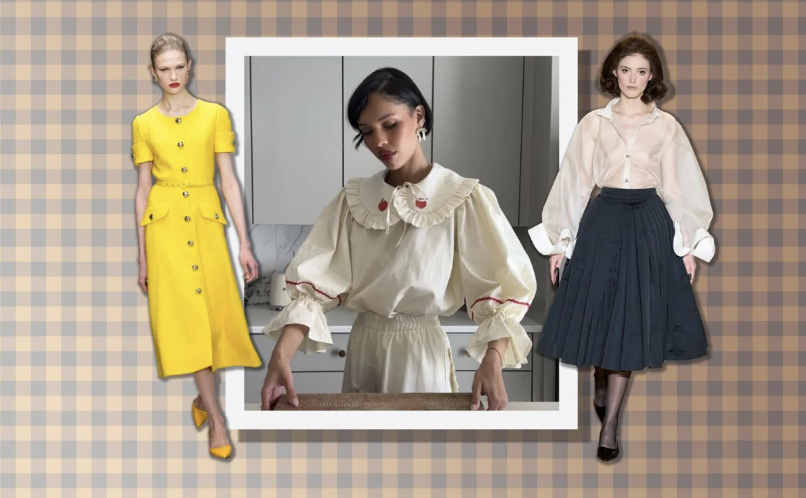
Ever since Trump’s been elected president, I’ve noticed a significant resurgence of vintage clothing styles. A push for clothing styles that no longer just encompass the trendy, low-rise, baggy jean and niche-retro baby tee look, but rather, a more high-waisted trouser, high-trim wool cardigan, and 60s-inspired, white, lace babydoll dress look.


I believe that this shift directly reflects a push for a more modest, conservative, and “quiet luxury” type of fashion, and it’s growing in popularity on almost every corner of social media. I’ve seen more and more women opt for a more ‘business casual’ look when going clubbing rather than the previously popular leather mini skirt and crop top look. Even for this summer’s swimsuit style, 50s-inspired tankinis and full-coverage swimdresses have become a popular preference, as opposed to previously preferred bikinis.
The most significant shift in fashion that I’ve noticed is the PrettyLittleThing clothing company’s recent 2025 rebrand. This company grew in popularity during the 2016 to 2023 streetwear style era, and from what I remember, this style reflected the “baddie” aesthetic: a type of aesthetic emphasizing graphic tees, crop tops, flare leggings, sneaker culture, and hourglass figures, a specific look popularized by Black and Brown women.
From 2016 to 2023, this was how almost every young woman wanted to dress and look, and public figures like Kim Kardashian and Kylie Jenner emphasized this desire by seemingly having curvier bodies, tanner skin, wearing slim-tight bodysuits, crop tops, cargo pants, and branded athleisure.
However, recently, the brand conducted a full stylistic reset. Instead of having primarily curvy Black and Brown models, their models appear significantly skinnier, with lighter skin, and more Eurocentric features. Instead of selling stacked jeans, graphic crop tops, and flared leggings that used to favor a diverse range of body types, they’re promoting slim-cut trousers, full-length sundresses, and modestly cut tops that are seemingly only advertised to slimmer figures.
The Resurgence of Skinny Culture
This push for a leaner, slimmer, and less curvy body type isn’t just something out of the blue –it reflects a common historical pattern between society’s socio-political understanding of women, their “role” in society and the ideal body type.
This point is made even more clear in a video posted by popular TikTok user Quincy Whipple, in which she describes how, throughout history, the ideal female body type fluctuates in size depending on how the country perceives the socio-political power and autonomy of women. She says, “When society sees women as a threat, the ideal body type changes and shifts to make women weaker and less threatening”.
Whipple proceeds to use an example of how, during the Roaring Twenties, after women gained the right to vote, the ideal female body type shifted from the Victorian hourglass figure to an extremely thin, and perceivably weaker body type. She implies that this change was likely an attempt to disempower women’s increasingly powerful and politically intimidating image at the time.
She compares this change to this year’s recent shift in the ideal female body type, implying how: due to the increased presence of impactful women in politics (politicians like Kamala Harris, Alexandria Ocasio-Cortez, etc), society’s felt a need to counter this perceived power –this imbalance in the American patriarchal system– by weakening the image of women and promoting a more conservative standard.
Online, more women, including young girls, are looking at the bodies of runway fashion models, those of which are typically unrealistically thin, as the standard for what an ideal and “beautiful” body type looks like. There’s an increase in discourse surrounding “working out to get skinny for the summer”, “not rewarding yourself with food”, and influencers like Brooke Schofield promoting strict dieting practices.
Moroccan feminist writer and sociologist Fatema Mernissi makes this reality of a conservative cultural shift all the more apparent in her 2003 article, Size 6: The Western Women’s Harem. She references feminist author Naomi Wolf, who argues, “‘A cultural fixation on female thinness is not an obsession about female beauty,’”…It is ‘an obsession about female obedience. Dieting is the most potent political sedative in women’s history; a quietly mad population is a tractable one.’”
So, the Kardashians’ removal of their hourglass surgical procedures wasn’t just a silly coincidence; it reflects society’s ever-changing political view of women.
But How Was This All Achieved?: Conservatism’s Been Made ‘Chic’
Social media has made conservatism “chic” by no longer marketing its ideals as something generationally unrelatable, ‘out of touch’, or archaic, but rather as something mainstream, youthful, luxurious, and stylistically appealing.
The administration is pushing for a more pronatalist and theocratically-grounded society, in which a traditional family unit is valued and there is less mobility regarding individual female reproductive agency. And, coincidentally, the social media world’s been introduced to content that reflects similar values.
Specifically, we’ve seen an influx of stay-at-home mom influencers representing the traditional, #TradWife lifestyle: leading strict daily routines encompassing cooking and baking “from scratch” for their numerous children, wearing high-end, lavish, vintage sundresses, living in beautiful, rustic homes, and marrying orthodox religious men. These women seemingly live a life driven by underlying religious doctrine, traditionalism, and domesticity.
They’ve made a living portraying the alleged ‘feminine soft life’ as something easily economically attainable, aesthetically appealing in both presentation and beauty, and inherently “natural”, due to conservative belief surrounding women’s inherent or biological role in society.
They’ve romanticized a more conservative American past by emphasizing the “beauty” and “femininity” that vintage women’s fashion exudes, while simultaneously failing to represent the history of misogyny, socio-economic suppression, and domestic abuse endured by the women of that same period.
This romanticization pushes the belief that women will find peace, emotional satisfaction, and a deepened acquisition of femininity if they practice submission and domesticity. It disregards the very real reality that similar feelings of fulfillment can be also achieved beyond confining gender barriers.
It is almost like the media’s trying to market the fictional and romanticized ‘Americana’ lifestyle that Lana Del Rey sings about in her music as opposed to the unapologetic reclamation of agency and female individualism that Beyoncé’s Lemonade album echoes.
The Importance of Recognizing These Patterns and Trends
When it all comes down to it, there’s no problem in liking this new wave of fashion, buying a nice vintage sundress, or thinking tankinis are cute –I mean, I’d be lying if I said I didn’t like a good ballet flat and baby doll dress.
However, understanding and recognizing where this new wave comes from –this resurgence in vintage, modest fashion, and the push for more Eurocentric, thin beauty standards –makes the difference between a mindless and conscious consumer in today’s day and age.
While it’s completely fine to favor a vintage style and these specific manifestations of “feminine” qualities, it’s crucial to understand that there are other means of female self-fulfillment existing outside of conservative gender norms. The sooner we recognize this ubiquitous reality, the sooner we can reclaim our autonomy, agency, and individuality on our own terms, regardless of whatever lifestyle is trending.

Leave a Reply